
menu
menu
close
client
size
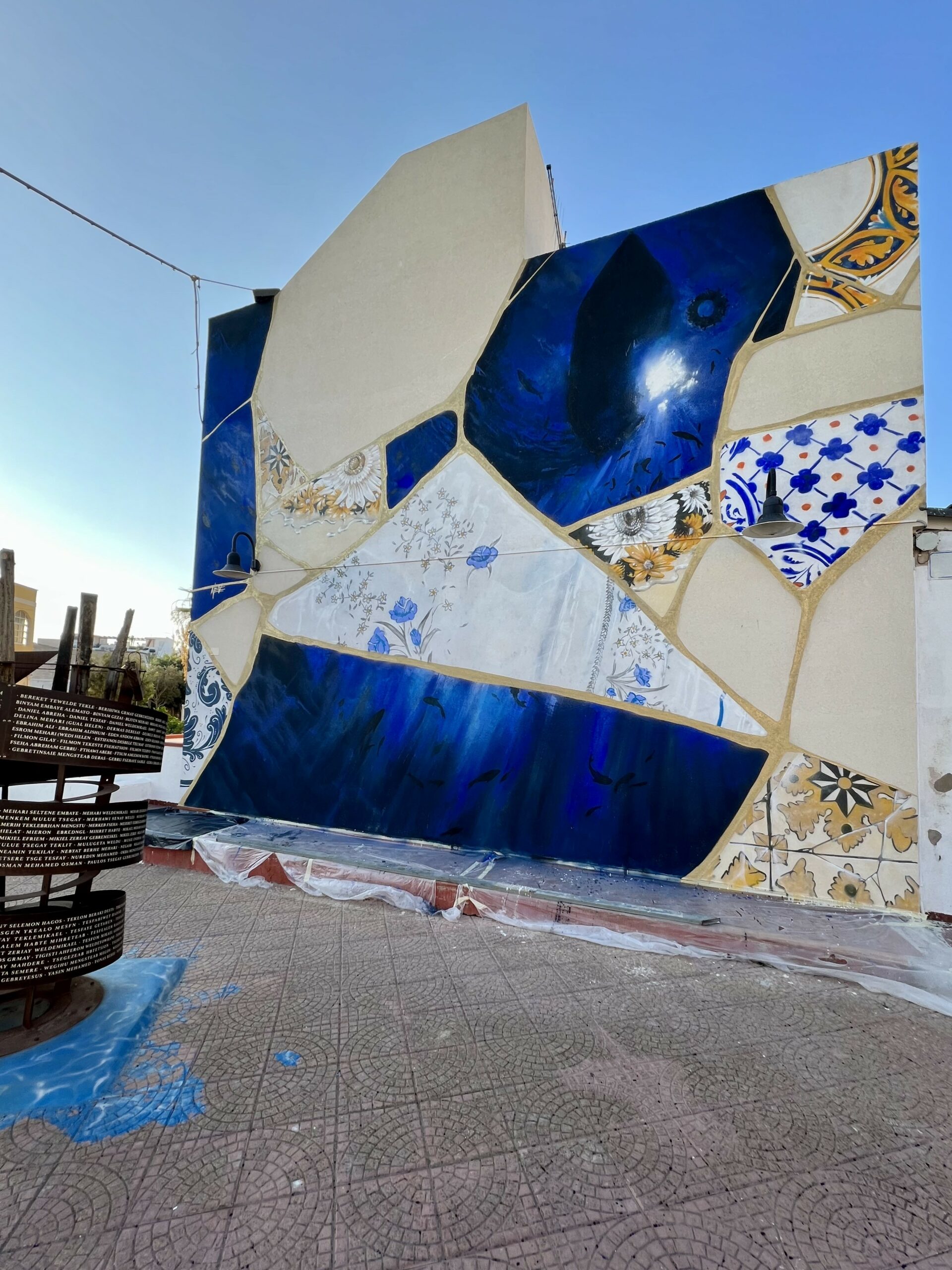
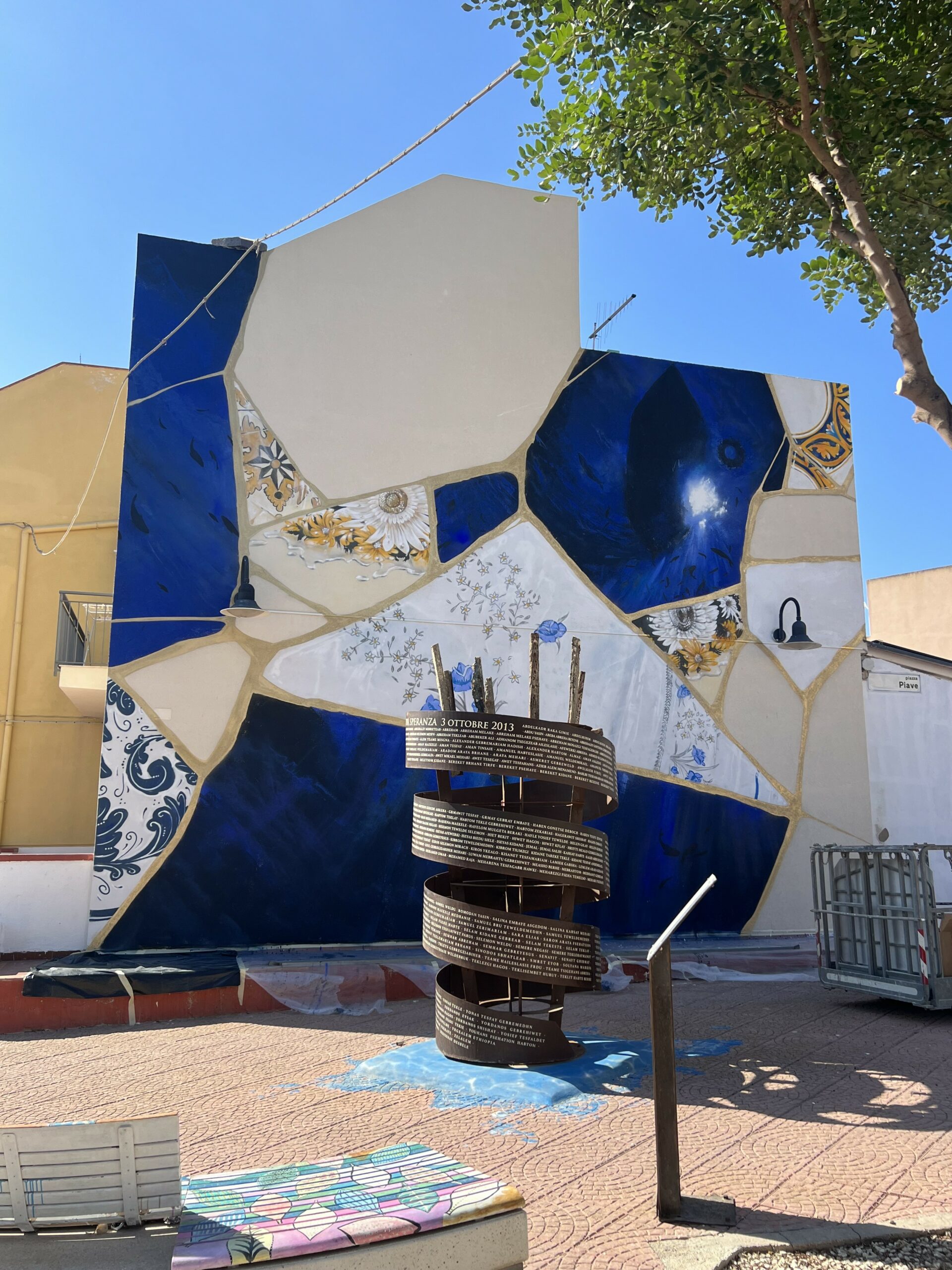
This mural was created by artist Neve in October 2023 in Lampedusa, on the occasion of the 10th anniversary of the October 3, 2013 tragedy.
A large-scale kintsugi mural painted in Lampedusa in late September 2023, in the days before the 10th anniversary of October 3, 2013 — the date on which 368 migrants drowned within sight of the island, an event that became the founding moment of Italy's National Day in Memory of the Victims of Immigration. The work is the second intervention by Neve on this wall in Lampedusa. The first — "La Corona" (2019) — depicted a funeral wreath of gerbera daisies and chrysanthemums, seen from below the surface of the sea, as if from the perspective of the drowned. This second work takes the kintsugi form: the entire building facade is broken into irregular shards joined by lines of gold, each shard carrying a different visual register. The dominant material is deep cobalt blue — the Mediterranean, painted as an underwater space in which a diffuse light source glows from above and dark fish silhouettes move through the water. Against and between these blue shards: fragments rendered as traditional porcelain and majolica — white grounds with intricate blue decorative patterns in scrollwork, wave-form ornament, and floral repeat; Mediterranean tile patterns in blue-on-white geometric and orange-on-white geometric forms, echoing the ceramic traditions of Sicily and the South. The origin of the china pattern is specific: during the making of "La Corona" in 2019, Neve had come to know Mamma Maria — an elderly woman who lived directly in front of the wall, and who watched the mural come into being from behind her open door, day after day. Mamma Maria had fed all the survivors of the 2013 shipwreck for days, gathering them around a long table in the square. After the 2019 painting, she told Neve about it. In the years since, she had died. Her daughter gave Neve one of her plates — a white porcelain plate with a blue floral pattern, cornflowers and small daisies, scalloped rim — as a relic of her mother. That plate is the origin of the china pattern that appears throughout the 2023 mural: the broken shards of the kintsugi composition carry the broken pattern of Mamma Maria's plate, the blue flowers of her crockery dispersed across the blue of the sea. The text of the work, as the artist wrote it: "This mural is not just a tribute to the victims but also to those who were there for the survivors. Because in the end, we all eat from the same plate." The De André reference the work carries — "Il Pescatore" ("The Fisherman"): "...non si voltò, non disse niente / ma nella notte je diede / da mangiare e da bere" ("...he didn't even look around but / poured the wine and broke the bread for those who said / I'm thirsty / I'm hungry") — frames Mamma Maria's gesture as a form of moral instinct so deep it requires no deliberation: the act of feeding as the original ethical act. The mural stands in front of an existing memorial monument — a dark curved stele inscribed with the names of the victims — already in the square.