menu
menu
close
client
size
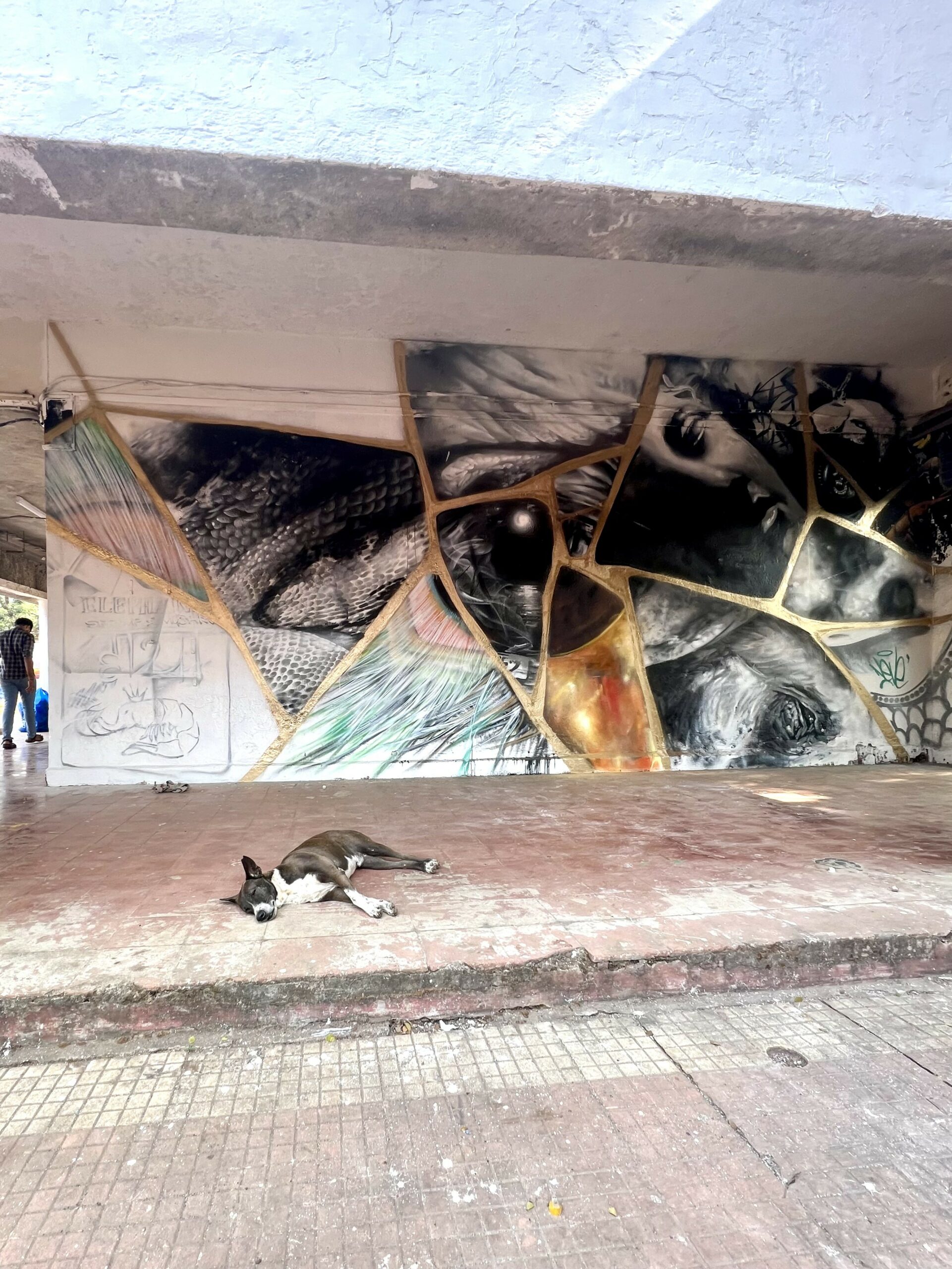
Baba (बाबा) is a mural created by artist Neve in December 2023 at IIT Bombay, Mumbai, for the Mood Indigo festival.
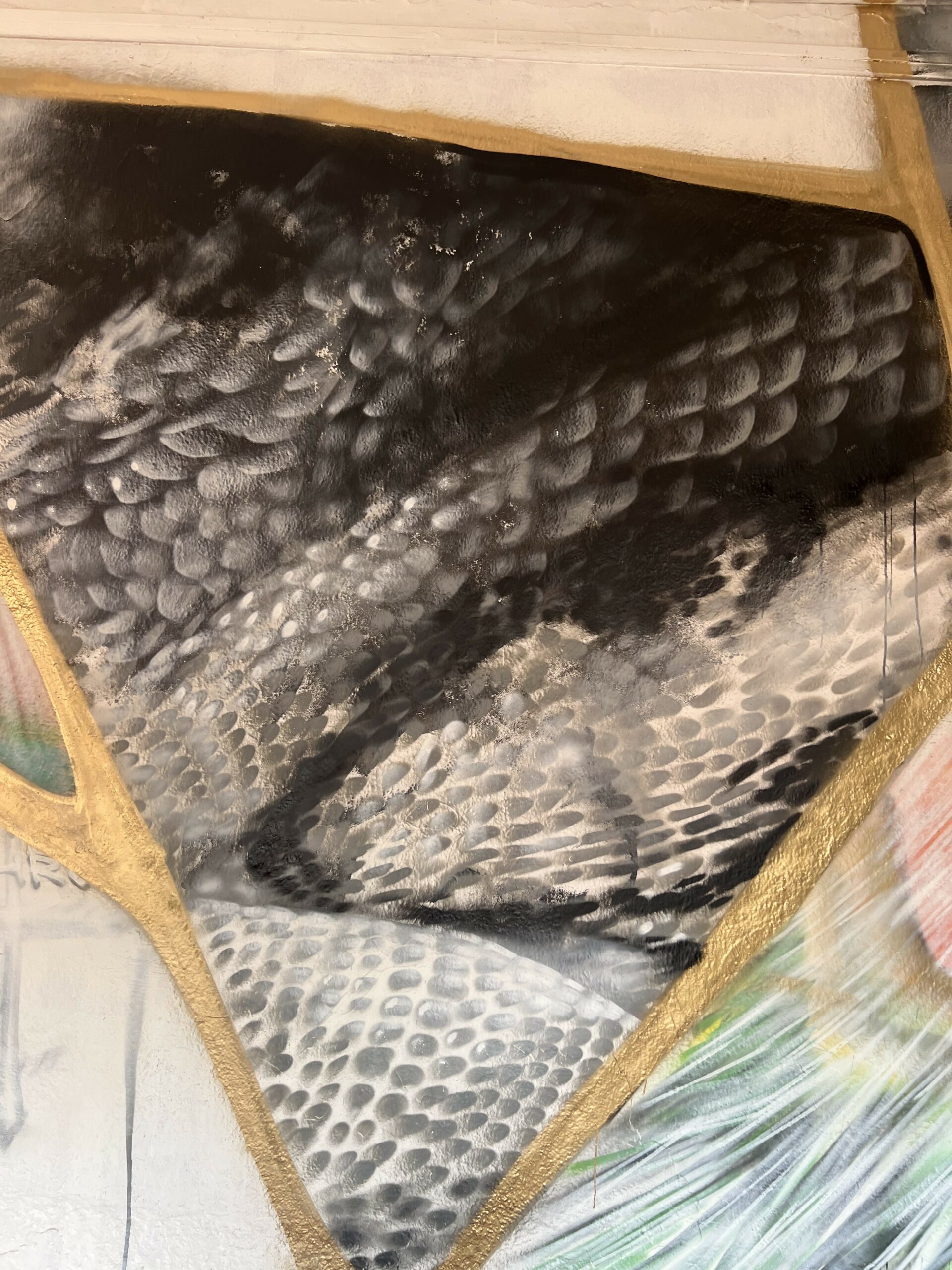
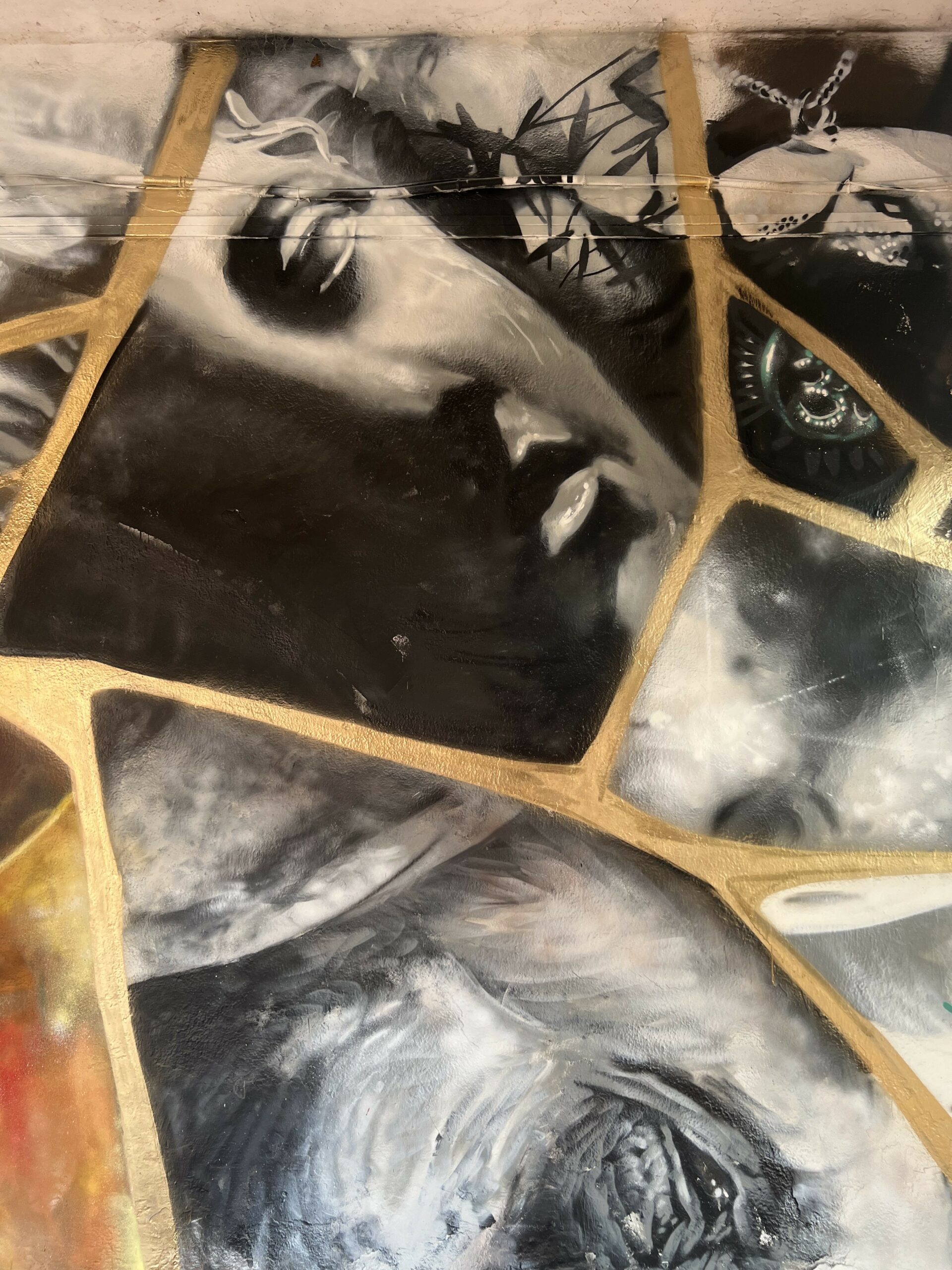
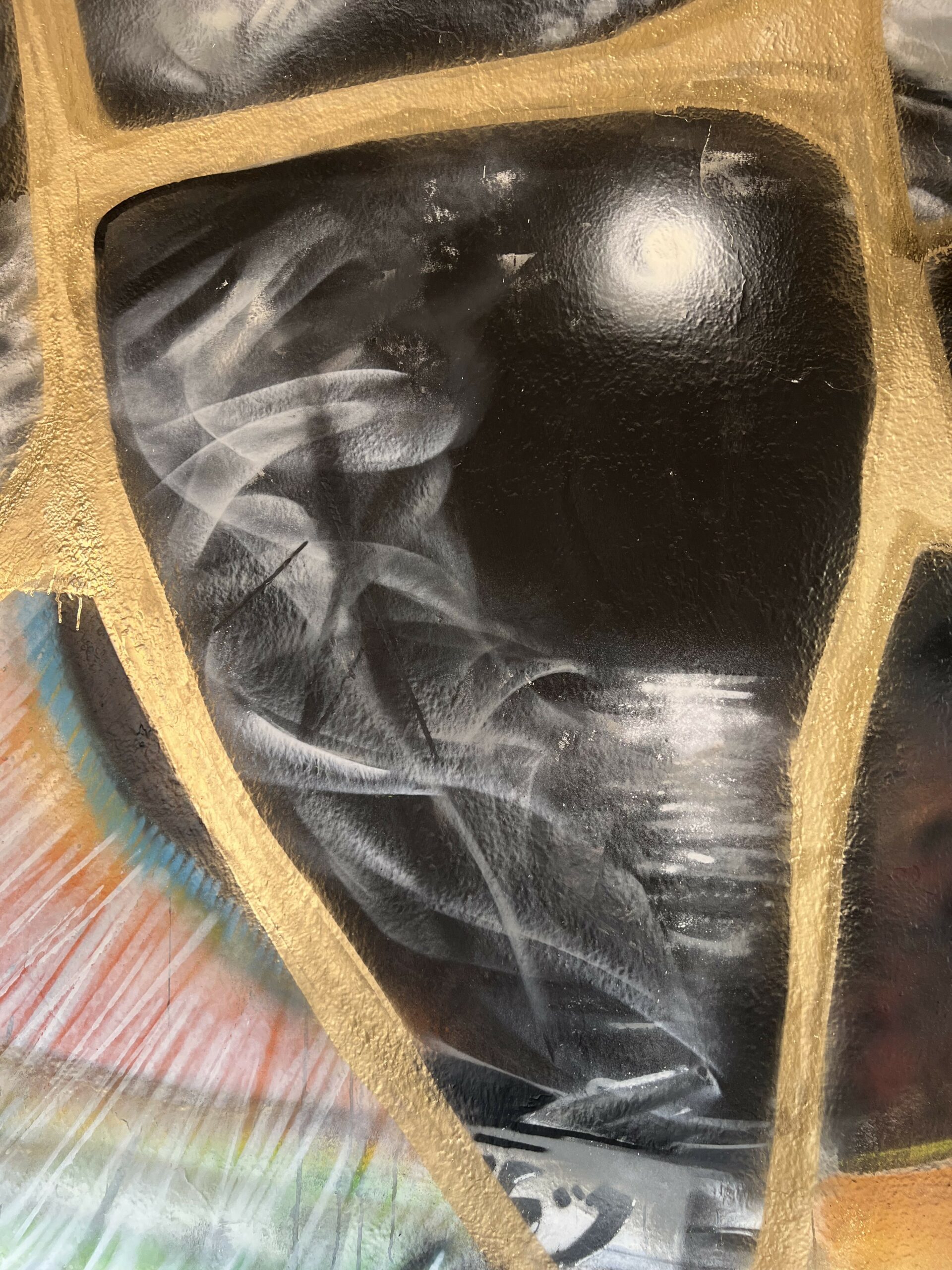
A large-scale mural painted in December 2023 at IIT Bombay, Mumbai, for Mood Indigo — the second of two works Neve made on campus during the same residency. The mural occupies the wall of a covered walkway or portico, its surface given shelter by a concrete ceiling, with the campus visible beyond. The work is built on the kintsugi structure — irregular fragments joined by gold lines — but here the gold grid serves a specific optical function: each shard carries a hyperrealist close-up of something from India, and when viewed from a distance, the fragments compose into a single great eye looking out at the viewer. The fragments include: The scales of a serpent — grey and white, rendered in extreme close-up, each scale overlapping the next with precision; the serpent is among the most ancient symbols of India, from the Nāga traditions to the coiled serpent at the root of the spine in yogic thought, from Shiva's ornament to Vishnu's bed. The tail feathers of a peacock — dense iridescent colour in the monochrome field: turquoise, green, gold, orange, each filament rendered; the peacock is India's national bird, a symbol of beauty, grace, and the monsoon. The skin and eye of an elephant — wrinkled, grey, ancient; the eye of the elephant rendered with the same attention as the human eye, looking back; the elephant carries Ganesha, the remover of obstacles, the first-worshipped deity. A butterfly — wings spread, the markings on its wing forming a pattern that recalls the eye or the mandala, the sacred diagram. Fragments of a human face — nose, lips — present within the composition as if the eye that the whole forms is also a human face looking back. At the centre of the composition: the pupil. A deep, glossy, near-black oval, with a single point of reflected white light at its surface — the eye fully rendered, the iris and the void of the pupil, atmospheric in its depth. The structural idea of the work: India is not a single image but an accumulation of details, textures, creatures, symbols — all teeming, all specific, all in close contact with each other. Viewed close up, each fragment is only itself: a scale, a feather, a wrinkle of skin. Viewed from a distance, they are one thing: the eye of India, looking back. The kintsugi gold that joins them is not repair but revelation — the lines that show how the parts cohere. The contextual photograph from the same days: a small stone shrine figure on the dashboard of a vehicle — Shiva, Parvati, and Ganesha, the divine family, dust-covered, behind a windscreen cracked in a web of fractures.