
menu
menu
close
client
size
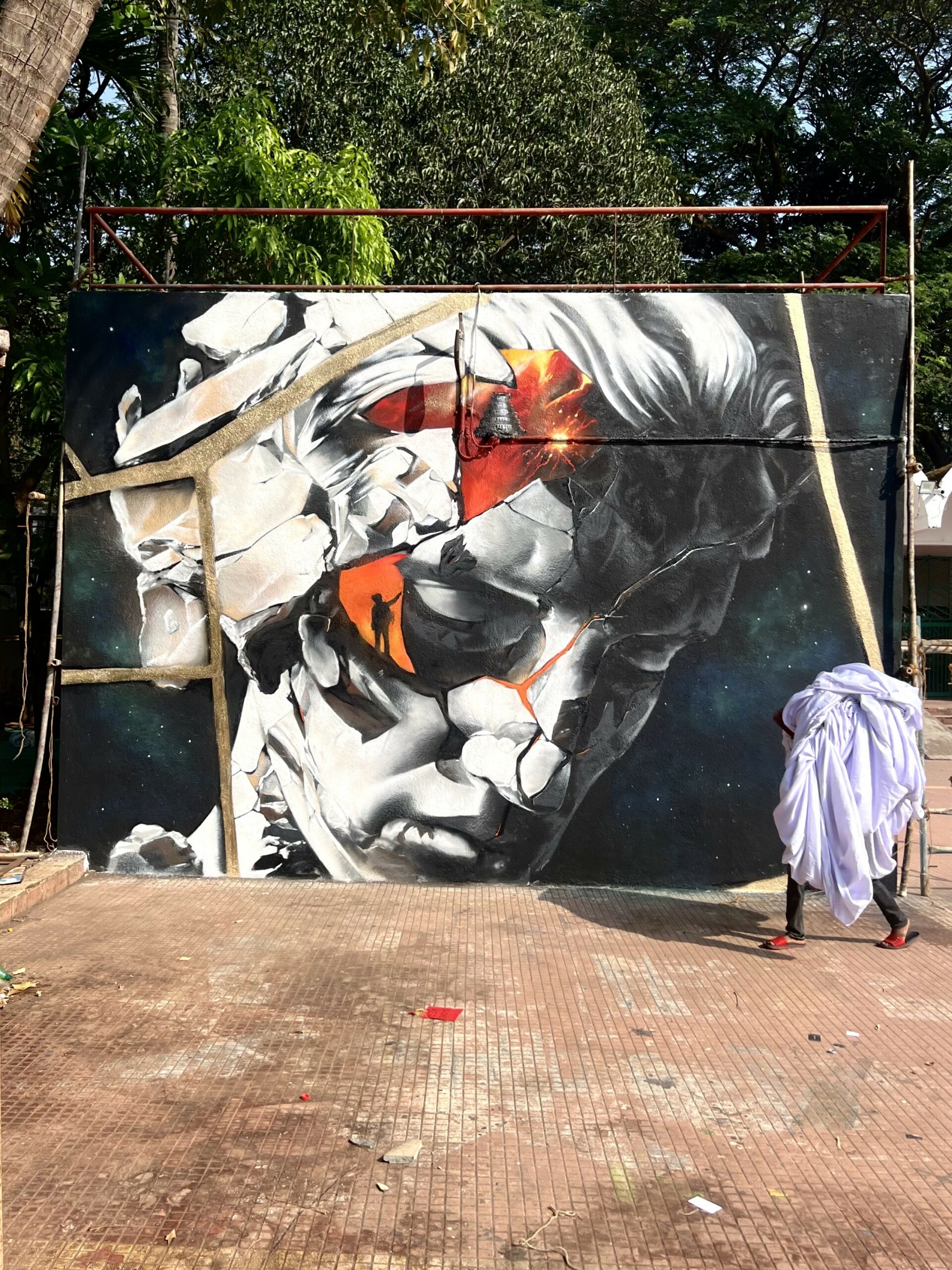
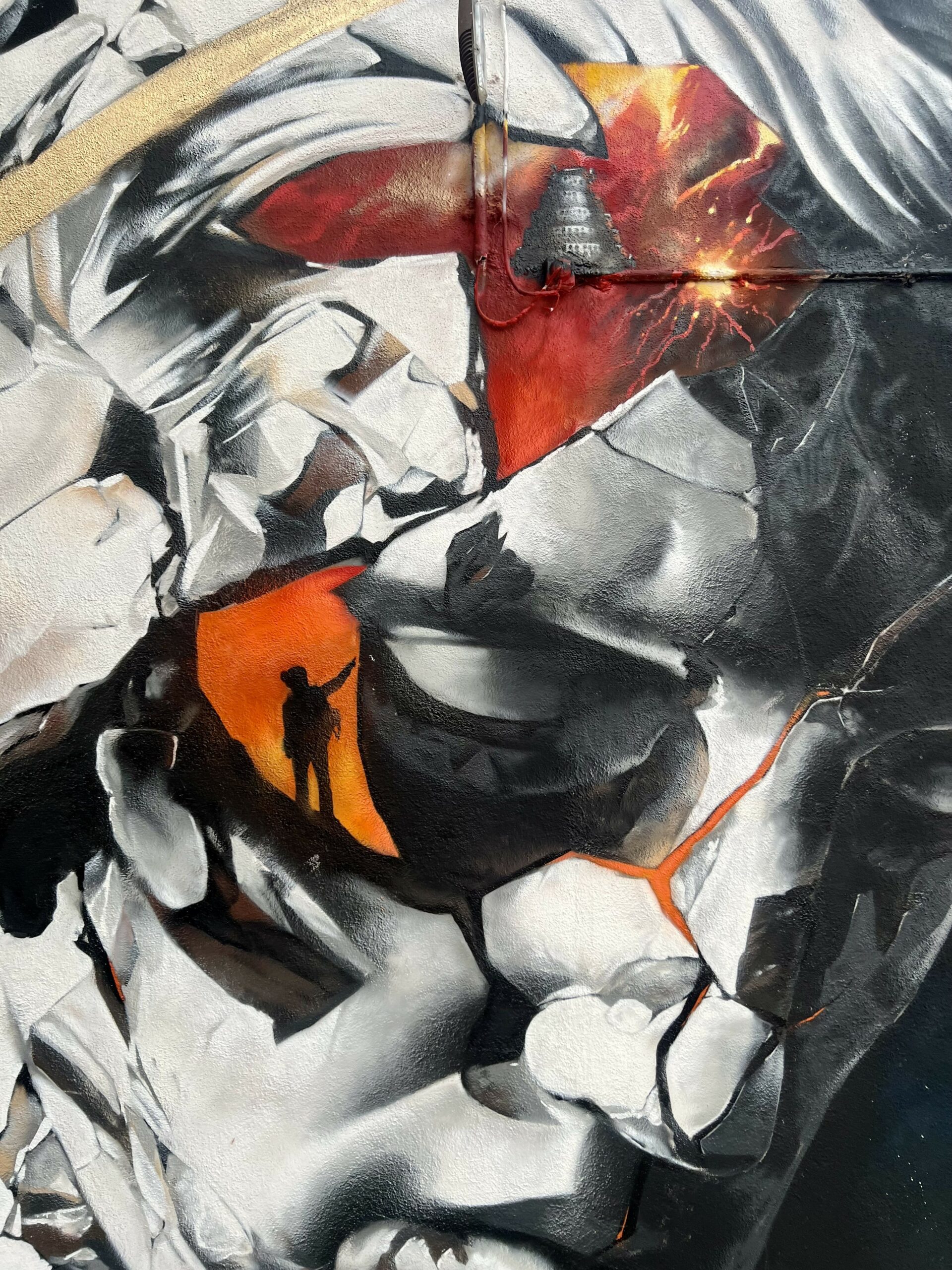
Vimana is a mural created by artist Neve in December 2023 at IIT Bombay, Mumbai, for the Mood Indigo festival.
"Vimana" is a large-scale outdoor mural painted in December 2023 on the campus of the Indian Institute of Technology Bombay (IIT Bombay), Mumbai, for Mood Indigo — the annual cultural festival of IIT Bombay, one of Asia's largest university cultural festivals. The work is painted in black, white and grey with a core of vivid orange and deep red — a palette that operates as a threshold: the monochrome exterior, the luminous interior. The subject is a massive classical stone figure — a head or bust, rendered in hyperrealist grey and white, as though carved from marble or cast in plaster — that is crumbling and shattering from within. The cracks do not open onto emptiness: they open onto a cosmic space, deep and dark, in which a fierce orange and red radiance burns. At the centre of the largest crack — a fissure that cuts across the lower part of the composition — a tiny black silhouette of a human figure stands inside the opening, arms raised or at rest, dwarfed by the scale of the rupture, looking up into the glow. Above the human figure, suspended in the heart of the light, is a small dark form — a bell shape, a disc, a vessel: the Vimana. Vimana is a Sanskrit word that appears throughout the ancient literature of India — in the Mahabharata, the Ramayana, and the Vedic Puranas — as the name for the flying vehicles of the gods and of ancient kings: aerial chariots, heavenly palaces in motion, the craft in which divine beings traverse the sky. In the modern reading — particularly in the tradition of ancient astronaut theory — the Vimana is reinterpreted as technology: a real flying machine, described in texts thousands of years old, evidence of an advanced ancient civilisation. The idea is that what the ancient texts called divine is what a later age would call extraterrestrial or technological; that the rupture between the sacred and the scientific is an illusion, and the oldest texts are the most precise records we have. The mural makes this idea physical: the stone exterior of civilisation — the classical figure, the inherited Western image of thought — cracks open to reveal that what was inside all along was something ancient and luminous. The small human at the threshold is the viewer, or the seeker; the Vimana in the glow is what was always there, waiting in the fracture. The series of contextual photographs taken during the Mumbai stay extends the work's visual logic: the ancient rock-cut columns and carved interiors of a cave temple (reference and inspiration); the density and chaos of Mumbai's streets; the cityscape in which glass towers rise above informal neighbourhoods still in the process of being cleared.