
menu
menu
close
client
size
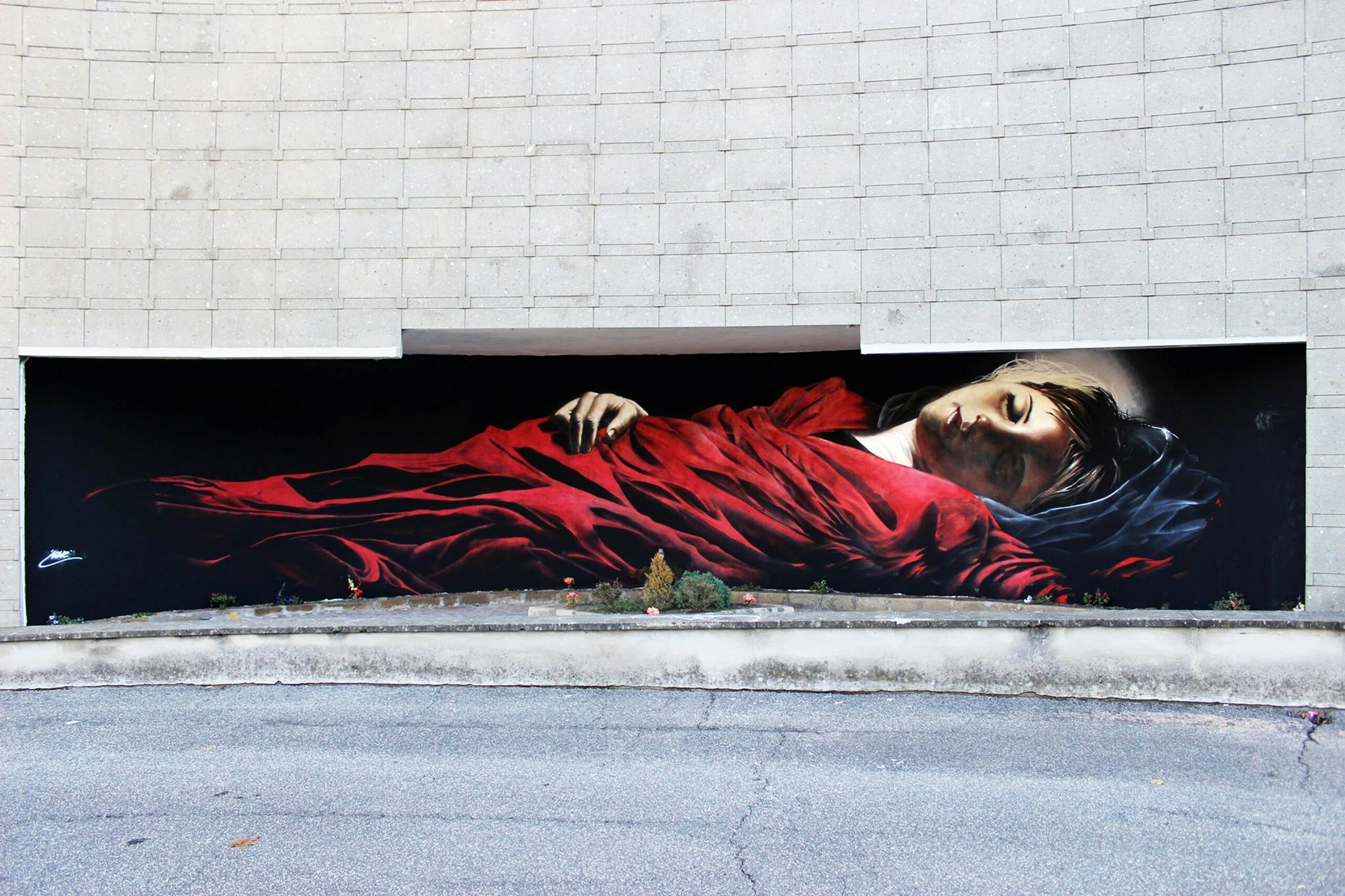
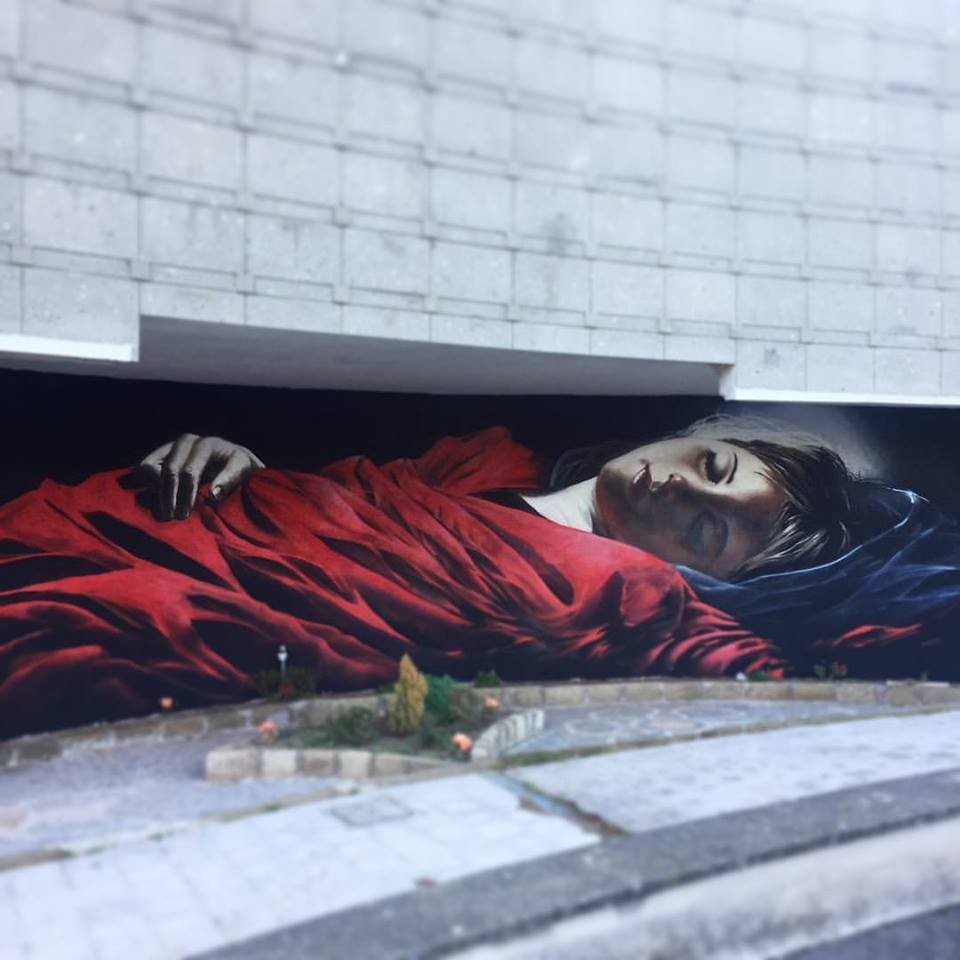
La Morte della Vergine is a mural created by artist Neve in December 2016 in Castel Gandolfo, Rome, curated by Franco Galvano.
"La Morte della Vergine" was painted in December 2016 on the wall of a building facing the papal villa of Castel Gandolfo, curated by Franco Galvano. The subject is a woman lying horizontal in death — the Virgin Mary. She is draped in a massive red cloak whose folds open and fall like a fire that has gone still: the fabric dominates the painting, deep crimson against the black ground, the movement frozen. Near her head, a dark blue cloth. Her face is turned slightly toward the viewer, eyes closed, an expression of absolute rest. One hand extends over the red, fingers open. The reference is exact. Caravaggio painted his "Death of the Virgin" between 1601 and 1606 for the church of Santa Maria della Scala in Rome. The painting was rejected by its commissioners — the Virgin looked too human, too dead, not transfigured. The model, according to tradition, was a woman found drowned in the Tiber. The work was bought immediately by the Duke of Mantua on the advice of Rubens. It is now in the Louvre. Neve's painting returns the subject to Rome — and places it not in a church but in the open air, on a wall in front of the seat of the papacy, at street level where anyone passing can see her. The recessed space under the overhang frames her like a stage or a niche: the architecture does not contain her, it presents her. The small garden strip at her feet, with its low plants and scattered flowers, grows at the base of the painting as if placed there in offering. To close the circle Caravaggio opened: to bring back to Rome what Rome refused, and set it down in front of the house of the Pope.