
menu
menu
close
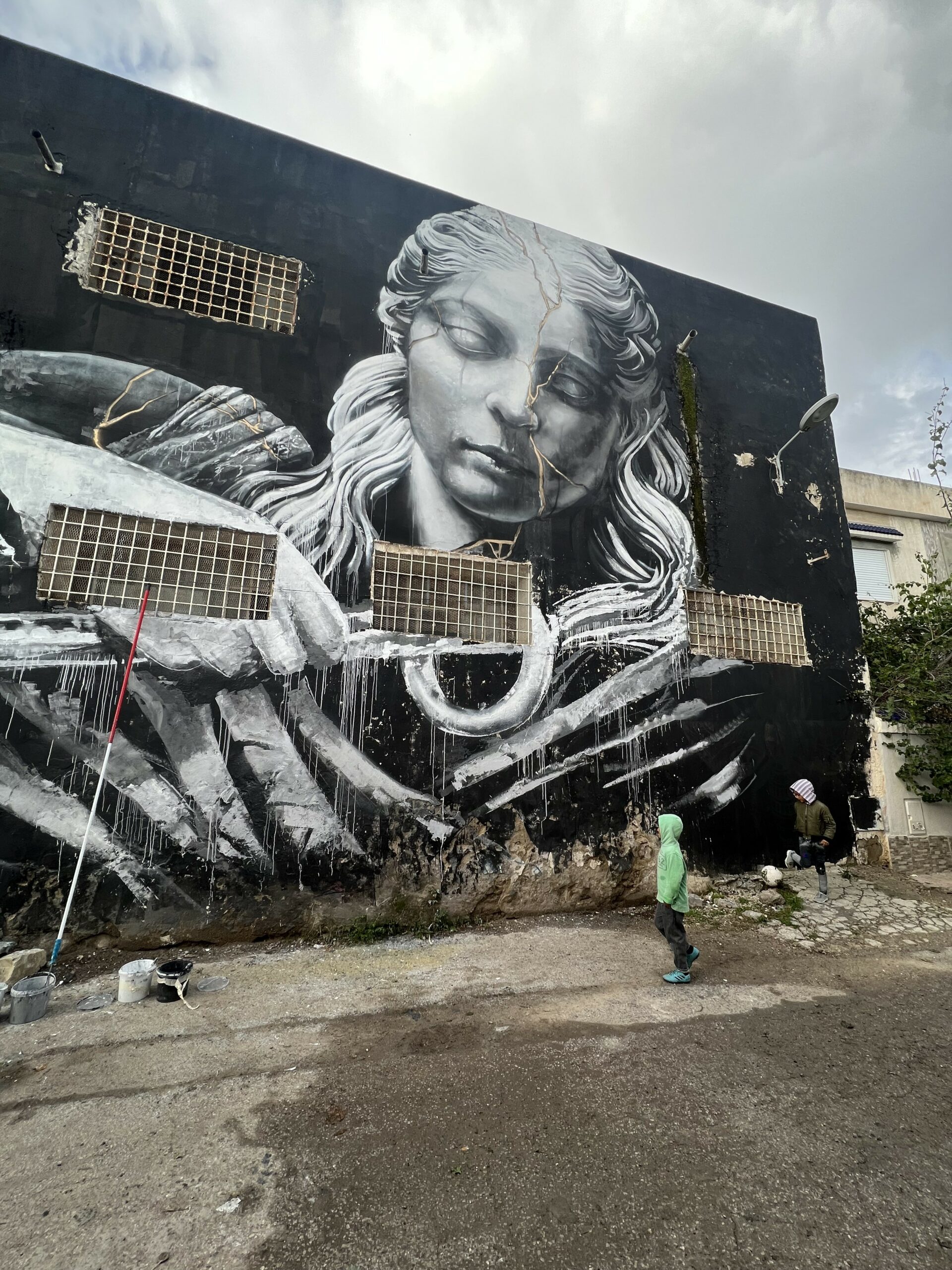
In Tunisia I spent intense weeks in a rough working class district tied to the old cement factory area near Djebel Jelloud, the same neighborhood connected to Chokri Belaïd, the Tunisian lawyer and political leader whose assassination in 2013 became one of the defining moments of modern Tunisian history. It was one of the most important walls of my career. At the time I couldn’t find the spray paint I normally used, so I ended up painting with almost nothing: one bucket of white paint, one bucket of black paint and just a few grey spray cans. That limitation completely changed the way I worked. For the first time I was forced to seriously use rollers and brushes instead of relying almost entirely on spray paint, and from that moment my whole approach to muralism started changing. That wall taught me that adaptation is sometimes more important than technique. I still remember the atmosphere of those days: the fish markets full of cats, the smell of the Medina, shops overflowing with objects and old books, and a butcher shop with a cow’s head hanging outside, blood slowly dripping onto the street. I met wonderful people there, both locals and artists from other parts of the world, and that experience left a deep mark on the way I paint even today.
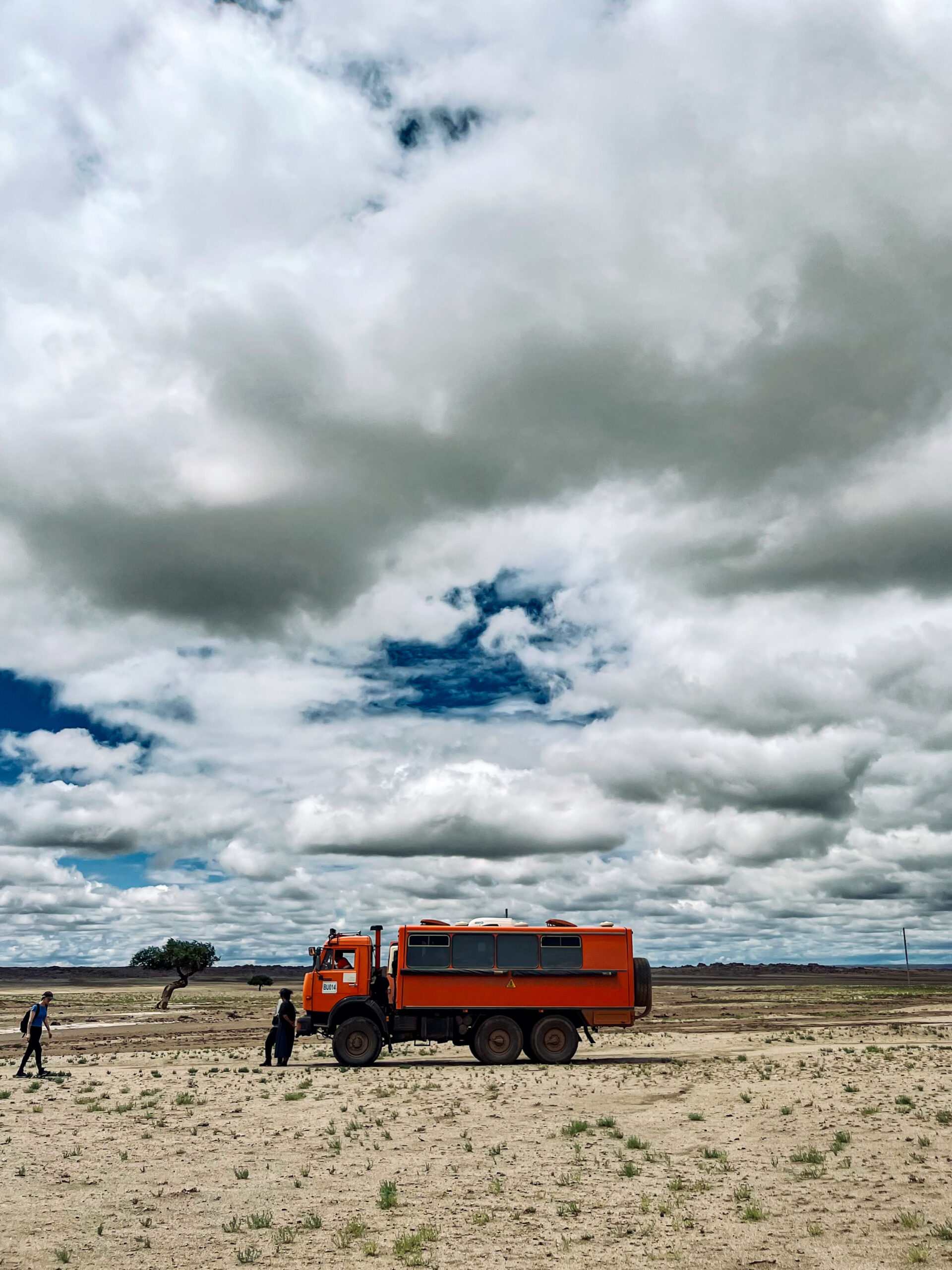
There is a moment, while painting a wall, when the work stops being only mine. It usually happens before the mural is finished. Someone passes by, stops for a few seconds, looks at the image and begins to connect it to something personal. A memory, a place, a story, a fear, a hope. At that point the painting has already started to move away from the studio, from the sketch, from the original intention. It has entered public space. This is one of the reasons why I have always been interested in muralism. A wall is not a neutral surface. It belongs to a street, to a school, to a neighbourhood, to a city, to a community. It carries previous layers of time, architecture, conflict, weather, habit and memory. When an artist paints in public space, the image is never isolated. It immediately begins a dialogue with everything around it. In recent years, muralism has become one of the most visible forms of contemporary art. Cities, institutions and private companies have understood the power of large scale images. A mural can transform the perception of a place, reactivate forgotten architecture, create identity and attract attention. But visibility alone is not enough. A mural can be technically impressive and still remain superficial. It can be monumental and yet disappear from memory very quickly. What makes an image last is not only scale. It is depth. This is where symbolism becomes important. A symbol is not simply a decorative element or a reference to the past. A symbol is a structure that keeps meaning open. It does not close the interpretation. It invites it. A face can be beautiful, a composition can be balanced, a technique can be refined, but when an image contains a symbolic layer it can continue to generate questions long after the first visual impact has faded. This is why I often return to mythology, allegory, classical references, spiritual imagery and archetypal figures. Not because I want to recreate the past, and not because I believe contemporary art should imitate ancient art. I use these references because they still work. They still speak. They have survived because they belong to something deeper than fashion. Mythology, for example, is not only a collection of old stories. It is a language through which human beings have tried to describe forces that are still present today: desire, fear, violence, transformation, justice, peace, power, sacrifice, birth, death and rebirth. These themes have not disappeared. They have only changed form. When a mythological figure enters public space, it does not remain in the museum or in the book. It becomes exposed to the life of the city. It is seen by people who may know the original reference and by people who may not know it at all. Both readings can be valid. One viewer may recognise Eirene as the Greek personification of peace. Another may simply see a female figure holding a fragile balance in a fractured world. The image works when both levels can coexist. This coexistence is essential to public art. A mural should not require an academic explanation in order to be felt. At the same time, it should not be reduced to an immediate slogan. The strongest public images are often those that can be understood on different levels: visually, emotionally, culturally and symbolically. In my work, I often use objects and gestures as symbolic devices. A mirror can speak about identity, illusion, fragmentation or self knowledge. A vessel can suggest purification, offering, transformation or memory. A crack can become a sign of trauma, but also the beginning of a new structure. These elements are simple enough to be perceived immediately, but open enough to contain multiple interpretations. This is the balance I look for. A mural must be accessible, but not empty. It must belong to the present, but not be trapped by the present. It must communicate with people who pass quickly, but also reward those who stop and look again. Contemporary cities are full of images. Advertising, screens, signs, social media, political messages and visual noise compete constantly for attention. In this environment, public art risks becoming just another image among many others. Symbolism can resist this acceleration because it does not consume itself immediately. It asks for time. This does not mean that every mural should be obscure or intellectual. On the contrary, symbols are often powerful because they are simple. The problem is not simplicity. The problem is emptiness. A strong symbolic image can be clear and mysterious at the same time. It can be readable from a distance and still reveal something more when approached closely. It can belong to a specific place and still speak to a wider human condition. For me, this is one of the most important possibilities of contemporary muralism. Public art should not only decorate walls. It should create relationships between people, places and meanings. It should be able to enter the daily life of a city without becoming banal. It should leave behind something more than a pleasant surface. I have painted in different countries, in very different cultural contexts, and each place has forced me to reconsider the meaning of the images I was creating. A symbol that carries one resonance in Italy may carry another in India, Tunisia or Mongolia. This does not weaken the work. It makes it more alive. The public space completes the image by adding its own history. This is also why I believe muralism remains one of the most interesting forms of contemporary art. It exists between painting and architecture, between private vision and collective experience, between permanence and disappearance. A wall can last for decades or be destroyed in a few years. This fragility is part of its truth. Perhaps the role of a mural is not to give definitive answers. Perhaps its role is to place a meaningful image inside the life of a community and allow that image to change together with the people who encounter it. In this sense, symbolism is not an escape from reality. It is a way of making reality deeper. And in a time when images are produced, consumed and forgotten at incredible speed, depth may be one of the most radical things a public artwork can still offer.